














The AI conversation has changed. No more breathless announcements about the next big model size or endless token counts. Businesses have moved past the “let’s try it” phase. Now it’s about what actually sticks – what delivers dollars, cuts hours, or keeps regulators off your back.
Early adopters who deployed thoughtfully are seeing real lifts: faster decisions, leaner teams, happier customers. The rest? They’re dealing with ballooning cloud bills, stalled pilots, and teams quietly wondering if this was all hype. The winners treat machine learning like plumbing – essential, invisible when it works, and expensive when it breaks.
Here’s what’s really moving the needle for companies right now, based on where the money, failures, and quiet successes are piling up.
Agentic AI: Agents That Actually Finish the Job
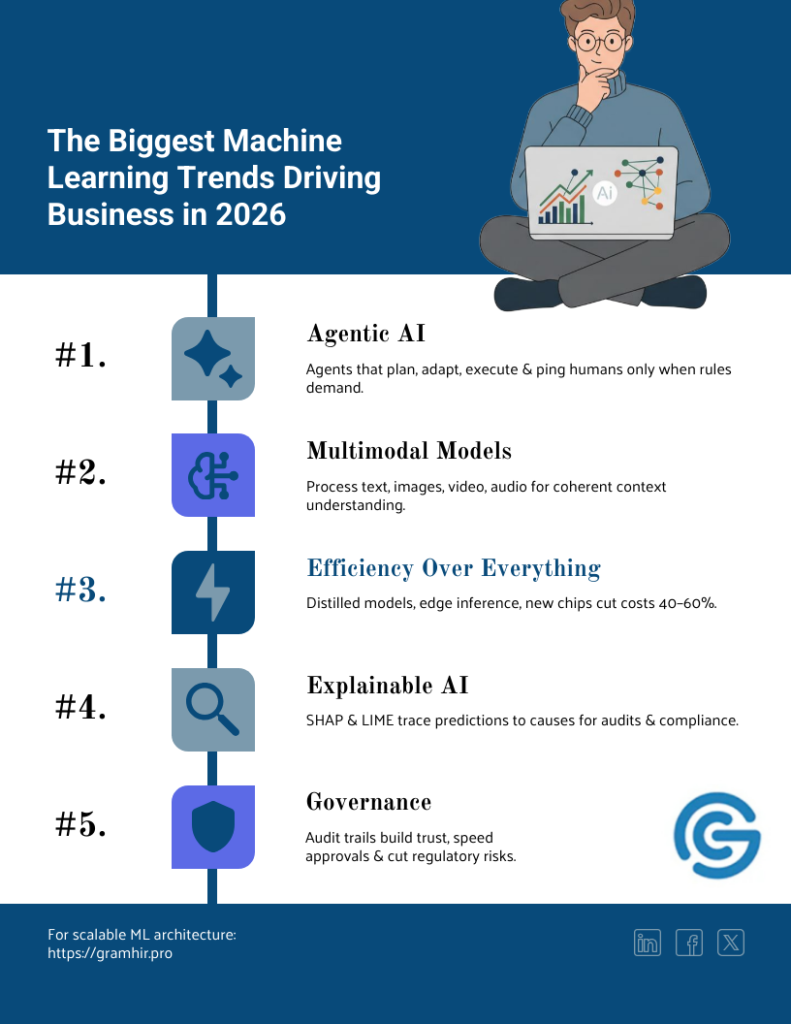
Forget polite chatbots that suggest next steps. Agentic AI in 2026 means systems that plan, adapt, execute, and only ping a human when rules demand it. Gartner already warns that by end of 2027 over 40% of early agentic projects will get scrapped – mostly because companies jumped in without solid foundations. But the ones that survive? They’re rewriting ops.
Think supply chains where agents monitor demand, negotiate with suppliers, reroute shipments during delays, and update forecasts – all in near real time. Or customer service where an agent swarm handles 80% of routine issues end-to-end (Gartner sees that hitting by 2029, but aggressive players are already pushing 50–60% in pilots). Forrester points out enterprises are starting to mandate AI fluency training because agents change who does what.
The business math is brutal and beautiful. PwC-style reports show focused agent deployments shaving 20–40% off process times in ops-heavy areas. Yet legacy spaghetti code kills most attempts. Smart organizations rebuild APIs and data pipes first.
For more on scalable, business-aligned ML architecture, see https://svitla.com/expertise/machine-learning/
Multimodal Models: Context That Finally Makes Sense
Single-sense AI feels limited in hindsight. Multimodal models chew through text, images, video, audio, sensor streams – whatever reality throws at them – and spit out coherent understanding.
In manufacturing, a system watches live video feeds, listens to machine hums, reads telemetry logs, and predicts failures days early. Healthcare teams combine patient notes, scans, voice recordings from visits – catching subtle patterns one modality misses. Retail analyzes in-store camera footage alongside purchase history and online reviews for spot-on personalization.
Experts like those at Oxagile note multimodal as one of the clearest shifts this year: models that “perceive the world more like we do.” IBM highlights sports broadcasting examples – real-time stats overlaid on video feeds – that scale commercially.
Challenges remain: data sync issues, heavy compute needs, latency in critical paths. Winners invest in unified platforms upfront. The payoff? Decisions grounded in full context, not stitched-together reports.
Here’s what businesses gain most from multimodal in practice right now:
- Deeper anomaly spotting – Fraud or defects hide in cross-modal mismatches that text or vision alone overlook.
- Smarter personalization – E-commerce blends user video behavior, chat logs, product images for recommendations that actually convert.
- Fewer handoffs – Agents verify across inputs, slashing manual reviews by 30–50% in mature setups.
- New products unlocked – Media companies auto-generate clips from raw footage + commentary + audience sentiment.
- Better risk management – Insurance assesses claims with photos, descriptions, telematics – faster and fairer.
Efficiency Over Everything: The Cost Reckoning
GPU euphoria crashed into reality checks. In 2026, cost optimization isn’t a side project – it’s boardroom mandate number one.
Smaller, distilled, open-source models deliver near-top performance at way lower prices. Edge inference moves compute closer to data, dodging massive cloud egress fees. New chips (ASICs, chiplets, even analog experiments) target agentic workloads specifically. IBM researchers talk about a fresh class of accelerators emerging just for this.
Finance teams report 40–60% inference cost drops after switching to optimized setups – same accuracy, half the bill. A mid-sized bank distilled multimodal fraud models and watched monthly spend plummet 55% without losing edge.
Lesson: Scale smart or bleed cash. Efficiency became table stakes.
Explainable AI and Governance: Trust You Can Audit
Regulators, boards, and customers demand to know why a decision happened. Explainable AI (XAI) shifted from academic nice-to-have to compliance requirement.
Tools like SHAP, LIME, counterfactuals, and native interpretability layers trace predictions back to root causes. In finance and healthcare, audit trails for high-stakes calls speed approvals and cut risk.
Deloitte calls it the “great rebuild” – AI-native companies design transparency in from day one. A lender using XAI lowered model risk scores and sailed through audits faster. Trust accelerates adoption; opacity stalls it.
Final Thoughts
In 2026, machine learning feels less like magic and more like mature infrastructure. Agentic systems automate messy workflows, multimodal delivers context-rich intelligence, ruthless efficiency keeps budgets sane, and governance builds lasting trust.
The gap between leaders and everyone else grows stark. Companies that integrate these trends thoughtfully – piloting high-ROI agents, benchmarking multimodal in core processes, auditing costs relentlessly – capture outsized gains: sharper edges, leaner operations, real competitive moats.
The rest chase features while margins shrink.
Start somewhere concrete: pick one painful workflow, deploy an agentic pilot with clear KPIs, measure multimodal uplift in a key decision loop, enforce cost discipline early. Execution separates winners from watchers.
Here’s to a year where machine learning finally stops promising the moon and starts quietly delivering results that show up in the numbers.



